
Bartholomew County Deed Records by Instrument
Every recorded deed names the parties and traces the land. It fixes the date the instrument entered Bartholomew County property records. It is the core transfer document. Read it beside the Recorder's related index entries. Those entries frame the instrument in the county's deed records. That one office also records mortgages, assignments, releases, real-estate contracts, powers of attorney, affidavits, surveys, federal tax liens, mechanics liens, cemetery deeds, and plats. Condominium instruments round out the list. Each class serves a purpose. Those companion records can explain financing, a released claim, or a lot split. They can also show the authority behind a transfer.
| Deed Type | What It Does | Common Use |
|---|---|---|
| Warranty deed | Conveys the described interest with stated title covenants. | Ordinary arm's-length transfers. |
| Quitclaim deed | Conveys whatever interest the grantor has without broad warranties. | Family transfers or correcting an ownership issue. |
| Personal representative or trustee deed | Transfers through an estate, trust, or other authorized fiduciary. | Probate and trust administration. |
| Sheriff's deed | Records a court-connected transfer following the applicable process. | Execution or foreclosure research. |
| Tax deed | Records a transfer arising from the delinquent-tax process. | Tax-sale chain research. |
A mortgage or lien records an encumbrance, not a new owner. A later release or assignment changes its status. Treat each deed, mortgage, assignment, release, lien, plat, and court order as separate dated evidence in the parcel's file.
DoxPop and the January 1963 Line
The county points online researchers to DoxPop for deed records. Individuals can search without a subscription. Subscription options exist too, and document copies can be purchased through the service. The Recorder describes its online land-document index as reaching back to January 1963. That date marks an index-coverage boundary. It does not promise that every image, field, or older document is available remotely.
Search names in several forms. Try surname first and last. Also try initials, married or former names, company suffixes, trust names, and obvious spelling variants. Keep the parcel's legal description beside the results. A party-name match without matching land proves little, especially when two people or businesses share a similar name. For the office's record classes and current directions, the official Recorder page is the source.
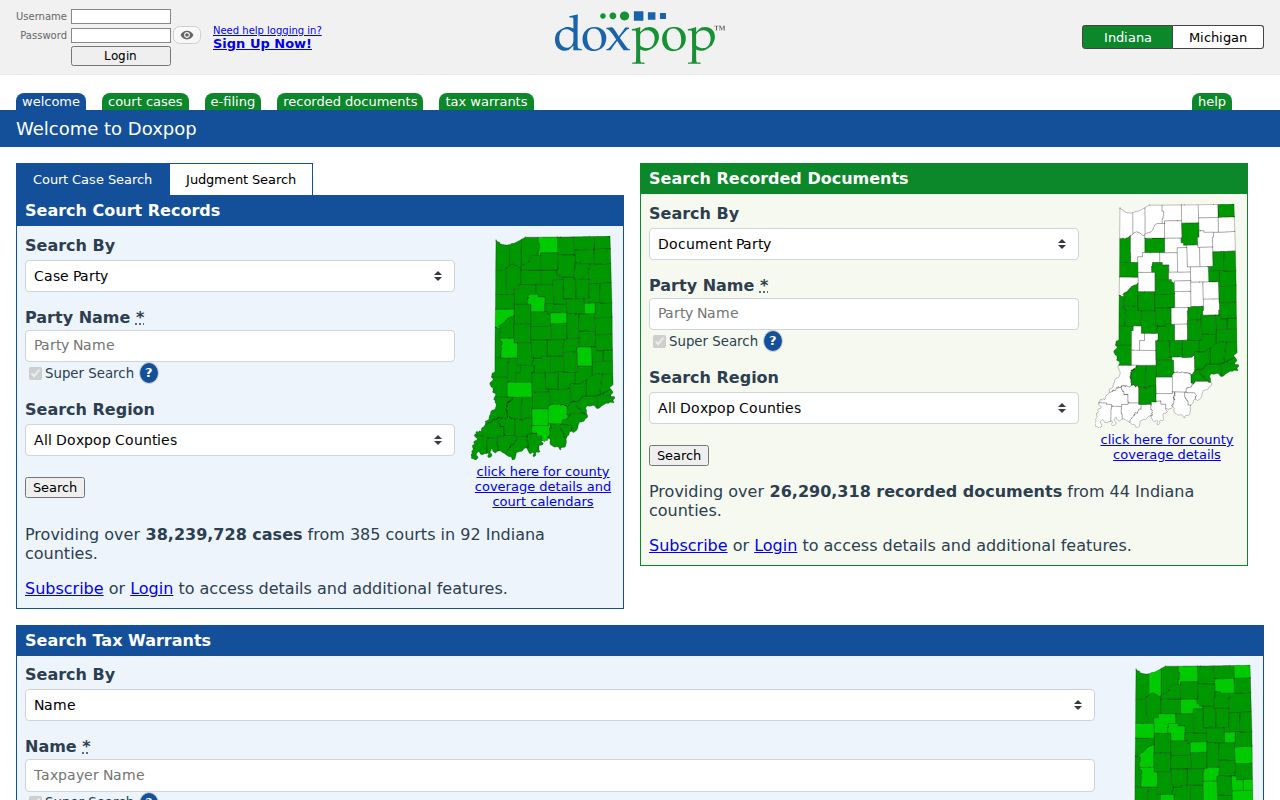
The DoxPop landing page is the remote doorway into Bartholomew County deed records. The Recorder counter remains the authoritative fallback whenever a live search field, image, or earlier reference is unavailable.
Walk the Grantor-Grantee Chain
Start with a deed you can identify for certain. The Assessor or Auditor lists the current owner of record. That name is only a lead. It points you toward the purchase instrument. Pull that deed and confirm the legal description, recording reference, dates, and both parties. From there, every prior grantor becomes the next grantee search. The Bartholomew County deed records chain walks itself backward one parcel transfer at a time.
- Find the present owner's acquisition deed with that owner indexed as grantee.
- Confirm the parcel by legal description, not merely street address, then record the grantor and instrument reference.
- Search the grantor as an earlier grantee and repeat, preserving execution and recording dates separately.
- At the January 1963 online boundary, take the last reliable book, page, party, and land description to the Recorder, Archives, or microfilm.
- Grantor
- The party conveying the stated interest.
- Grantee
- The party receiving that interest.
- Chain of title
- The ordered sequence of instruments affecting title to the same land.
- Book/page or instrument number
- The citation used to retrieve a specific recording; preserve exactly what the index supplies.
Before the Online Deed Index
Bartholomew County was formed in 1821, so its documentary trail stretches far past the online era. The surviving holdings include an Original Tract Book, an early deed index, and a General Deed Index A-P covering 1822-1851, plus specialized series such as Tax Titles and Sheriff's Deed/Execution materials. Older probate, civil, and miscellaneous books can also matter when land moved through an estate or a court proceeding.
The county Archives search accepts a category, surname or company, first name, and a keyword or year. Copies are listed at a $1 base plus $0.10 per copy and mailing; hours vary, and an appointment is advised. The Archives can be reached at 812-379-1503. Some older books were transferred to the Indiana State Archives in August 2017, so a complete request should ask whether the desired volume sits locally or in Indianapolis.
Use the Bartholomew County Archives search as one offline bridge. The State Library film guide and the local Historical Society are additional finding aids. Still, a directory entry, historic map, or society file is context, never a substitute for the recorded deed itself.
Older descriptions may lack a modern street number. Carry section-township-range, tract language, subdivision, lot and block, acreage, adjoining owners, and every book/page cross-reference. The Tax Titles and Sheriff's Deed/Execution series may be essential where delinquency or judicial process drove a transfer. When an estate is involved, tie the probate volume or cause to the later Recorder instrument rather than assuming the court record completed the chain.
One Parcel Can Carry Several Recording Dates
Execution, acknowledgment, recording, assessment, tax finalization, and court filing dates each serve a different purpose. A deed may be signed one day and recorded much later. The Assessor works from a January 1 valuation date. Treasurer information may stay preliminary until the county's stated April 8 point before mailing. Build a chronology instead of compressing everything into one "sale date."
That matters most for estate transfers, foreclosures, tax sales, annexations, and corrective deeds. A court docket or commissioners' minute can reveal the procedure. Only the recorded instrument establishes what actually entered the land-record system. Carry the Recorder citation into current-owner verification and the parcel identifier into the tax roll.
For a court-related transfer, preserve the cause number and search the proper court. Bartholomew Circuit is 03C01, Superior 1 is 03D01, and Superior 2 is 03D02. Local Odyssey access began December 5, 6, and not every document is online. Request missing papers from the Clerk or archives. Then return to the Recorder for the deed, lien, release, assignment, or certificate actually entered in the land record.
A clean chronology records what each source proves. A probate order may authorize an act. A sheriff's return may document procedure. An Auditor card may summarize ownership. A Treasurer record may describe tax administration. Yet none of these silently substitutes for the final recorded conveyance. Cite the instrument number or book/page. Copy the complete land description. Note any exception, reservation, easement, or cross-reference that directs the next search. Save both execution and recording dates, identify the custodian, and note the date you accessed the record for later verification.
Recorder Fees and Filing Standards
The Recorder posts example fees effective January 1, 2021. A deed within the stated size limit costs $25. A mortgage runs $55. Affidavits and other documents are $25, and so are releases, partial releases, and assignments. Copies run $1 per page for sheets 11 by 17 inches or smaller and $5 per page for larger ones. Certification or acknowledgment is listed at $5. These are source-dated examples, so confirm the current total before ordering or filing.
Formatting rules are strict. Paper may be no larger than 8.5 by 14 inches, with black ink of at least 10-point type on 20-pound stock. First and last pages need two-inch top and bottom margins, with half-inch margins on the sides and interior pages. CSC and Simplifile are the listed electronic recording vendors. A real-estate transfer also involves the sales disclosure and Auditor endorsement described in the county's transfer instructions.
Property Watch Is an Alert, Not a Lock
Bartholomew County residents can register a name or legal description with Property Watch. Multiple properties are allowed. The Recorder describes the service as free. It sends an email when a matching land record is indexed, but it does not stop a document from being filed, and it covers only records available in the application.
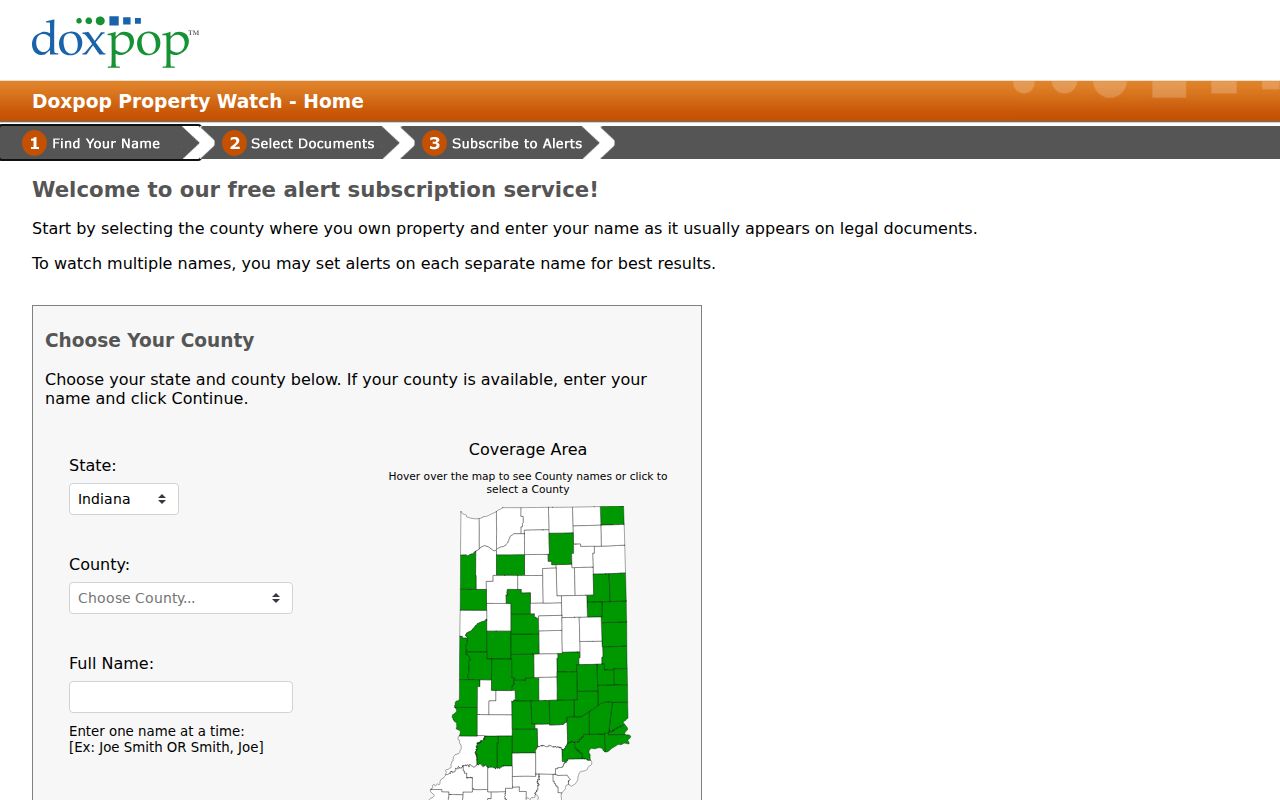
Treat an unexpected alert as a prompt to act. Save the instrument, contact the Recorder, verify the affected legal description, and seek legal advice when appropriate. An alert alone is not proof of fraud or invalidity.
Obtain a Bartholomew County Deed Copy
Buy an available image through DoxPop. Or contact the Recorder at 440 Third Street, Governmental Office Building, second floor, Columbus, Indiana 47201, telephone 812-379-1520. Staff can point visitors to general indices, books, and computer software. For a counter, phone, mail, or Indiana Access to Public Records Act request, give the parties, the approximate recording date, the document type, an instrument or book/page reference, and the legal description. Say whether you need an ordinary or certified copy. Ask for the current fee and delivery method too.
If the online search stops short, bring the last known deed citation to the counter. That beats starting from a broad family name. Estate and lawsuit research deserves extra care. Preserve the MyCase cause number and request the Clerk or archive file separately. The Recorder does not create new analyses, so ask for identifiable existing records with reasonable particularity.
Recorded, not guaranteed. The index reports instruments accepted into the public record. It is not a title opinion, does not resolve boundary uncertainty, and may not reveal unrecorded interests; use qualified title and survey professionals when the legal stakes require them.