
Comparing Bartholomew County Property Value Types
The Assessor certifies assessed values to the Auditor. The county describes its numbers as aiming to land within ten percent of what a property would fetch on the open market. Indiana's technical yardstick is market value-in-use, also called true tax value. A sale price is different. It records a single transaction.
Always pair any value figure with its source and its effective date.
| Value type | What it means | Where it is recorded |
|---|---|---|
| Assessed value | Mass-appraisal value certified for property administration | Assessor parcel record and Form 11 |
| Market value-in-use | Indiana's value concept for the property's current use | Assessment framework and record |
| Last sale price | Consideration from a past arm's-length or other reported transfer | Deed, sales disclosure, or parcel sale history |
| Land and improvement | Components that add to the parcel's total assessment | Assessor or GIS record |
Assessed value is not the last sale price carried forward. Through mass appraisal, Bartholomew County applies uniform rules. It also uses neighborhood evidence across many parcels at once. The gap grows when a transfer was non-market, a family conveyance shifted title, or a property had an unusual condition. The gap can also grow because the valuation date simply differs from the recording date. The Bartholomew County Assessor page publishes the official value dates. It also covers the GIS route for parcel-level detail.
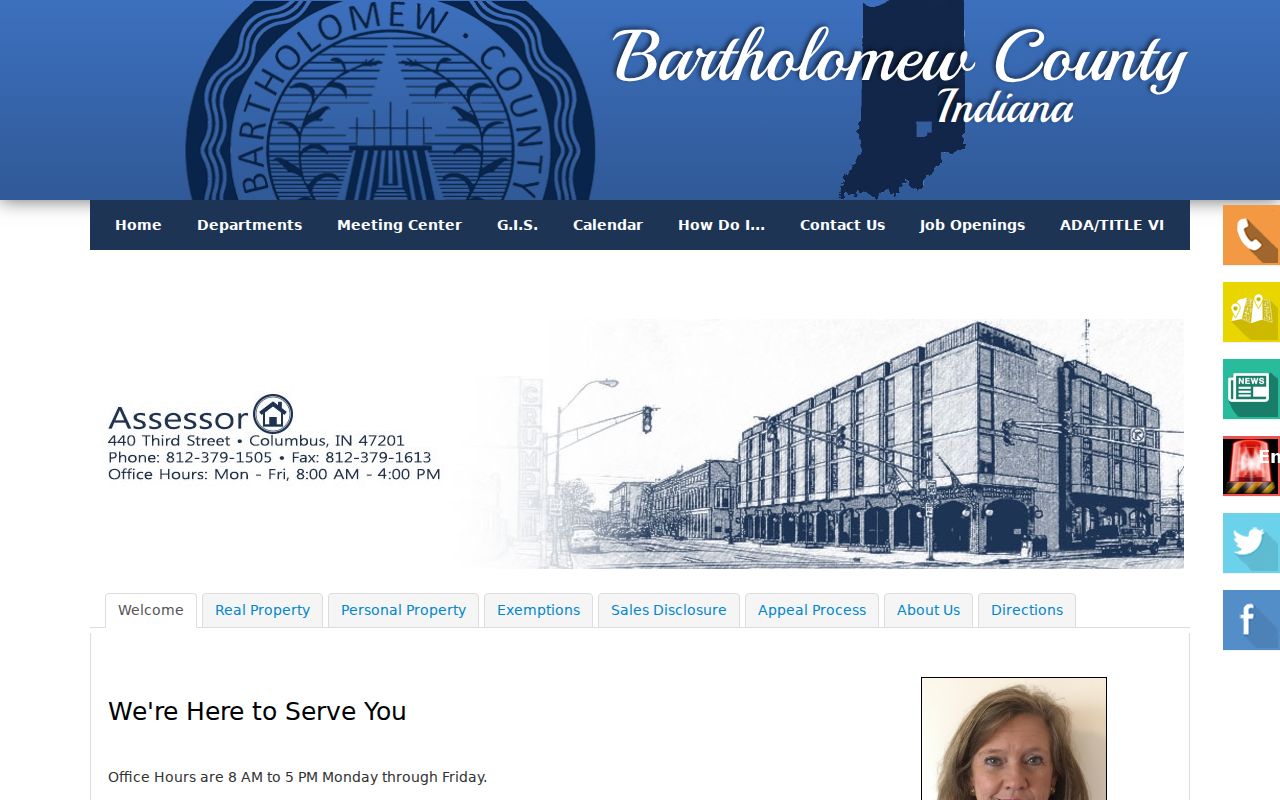
The official Assessor page anchors the whole value trail.
January 1 Sets the Bartholomew County Value Date
January 1 fixes the valuation date in Bartholomew County. Form 11 goes out near the end of April. It carries the assessed value as of that date. A September renovation or a spring sale can therefore sit outside the assessment on the screen. A recent demolition can do the same. Record the effective date before comparing parcels or years. The Assessor also inspects 25 percent of the county annually using imagery and field visits. Clay, Clifty, Haw Creek, and part of Columbus were listed for 2024. Flat Rock, German, and part of Columbus follow in 2025. Harrison, Jackson, Ohio, and part of Columbus come up in 2026. Rock Creek, Sand Creek, Wayne, and part of Columbus follow in 2027. That four-year geography explains why a physical fact can appear late in the records.
Separate Land and Improvements in a Bartholomew County Assessment
A Bartholomew County parcel record may show land, improvement, and total values. Land captures the site itself. Improvements cover the taxable structures and features the assessment recognizes. The sum matters more than any single field. A change can stem from the site, a building, or both at once. Before using a nearby assessment as context, compare the legal parcel and property class. Two close properties can differ in acreage, use, outbuildings, condition, deductions, or district. A neighbor's tax bill is a poor proxy for the subject's property value.
Place a Bartholomew County Sale Price in Context
Deeds live with the Recorder. The local transfer workflow adds a sales disclosure and Auditor endorsement. A reported price is a real market clue, but read it carefully. Identify the deed type, the parties, the date, and the legal description. Also check whether the transaction reflects an open-market sale. An old transfer cannot speak to current value on its own. Later improvements, splits, combinations, or a changed use may have altered the parcel since. A quitclaim, estate, sheriff, or related-party deed may not express a normal bargain either. That holds even when consideration appears on the face of the deed records.
Where Bartholomew County Property Values Are Recorded
The official Assessor page routes researchers to the county GIS map. Search by address, then verify the situs and parcel number before reading any value fields. The county-linked training material supports address, parcel ID, and owner-name search routes.
- Search the complete address in Bartholomew County GIS and verify the parcel number.
- Copy the land, improvement, and total assessed values with their assessment year.
- Review sale history only as dated context, then check the recorded deed when the transaction matters.
- Save the search date and do not compare unlike property classes or unmatched parcels.
- Assessed value
- The county's mass-appraisal figure certified for the assessment system.
- Market value-in-use
- Indiana's concept of value for the property's current use.
- Assessment ratio
- The relationship between assessed and market value; no unsupported local ratio should be assumed.
- Sale or consideration price
- The amount stated or reported for a transfer, which may not be a market transaction.
- Reassessment
- The process of updating taxable property facts and values for a new date.
Deductions Do Not Redefine Bartholomew County Property Value
The Auditor administers homestead, over-65 or circuit-breaker, blind or disabled, veteran, heritage-barn, model-residence, and other deduction materials in Bartholomew County. A deduction helps explain why two tax bills differ. It is not a sale. It does not change the owner of record. Keep gross assessment, deductions, taxable amount, and tax due as separate concepts when you read the tax roll. Valuation numbers are where this discussion stops. For installments, penalties, deductions, and the appeal route, consult the Bartholomew County property tax records guide.
Preliminary Tax Data Is Not a Final Value Statement
The Treasurer cautions that GIS property-tax information stays preliminary until April 8 before the scheduled mailing. It can change until then. That warning covers tax presentation. Form 11 and the Assessor record still provide the valuation trail. Label every saved screen by source. That way a preliminary tax figure never masquerades as a final certified bill or a fresh appraisal. When values disagree, compare parcel number, year, source, and value type. Only then call the mismatch an error. Many apparent conflicts are just different dates or distinct measures of the same property.
Compare Bartholomew County values across time. Use the same parcel in every row of a multi-year comparison. Use the same value type as well. List the assessment year, land value, improvement value, total assessed value, and source date. Add a note for any sale, addition, demolition, split, combination, or class change. Without those notes, a large percentage shift can look like a market move. The underlying property itself may have changed. Keep sale history as its own series. Mixing prices into the assessment column invites confusion. One parcel may carry several annual assessments but only a single old sale. A sound summary states how the assessed value changed. It then gives the dated consideration as context. It makes no claim that the two measures should match.
What a Bartholomew County Property Value Does Not Tell You
A Bartholomew County property value is not a promise. It will not tell you what a listing should ask. It will not say what a buyer will bid. It also leaves out what repairs a building needs. Assessments come from a countywide mass appraisal system. So they lag physical changes and skip the detail of a single-property inspection. A sale price has its own limits. It records one past transfer under circumstances that may never repeat.
Before comparing values across years, keep the parcel number handy. Check whether the legal parcel itself changed. A split, a combination, a new improvement, a demolition, or a classification shift can distort the picture. It can make a simple percentage jump look like growth. That growth never happened. Compare the land and improvement components separately before trusting the total.
A good summary line from the property records pulls everything together. It states the value type, amount, effective year, source, and search date. Note: that one line keeps a Bartholomew County property value from becoming an undocumented estimate. It stays sourced once it is shared.
Value is not price. A Bartholomew County assessed value supports taxation and is not what the property will sell for or a licensed appraisal.