
Charting Former Bartholomew County Property Owners
A backward chain works best as a working table. Give each row one transfer. Record both deed dates, the exact parties, the deed type, and the recording reference, since the latest grantee is only the starting point and the grantor above is the next former owner to chase. Keep it factual. The chain shows its form, not a real parcel result.
| Transfer date | Grantor to grantee | Deed type | Book/page or instrument |
|---|---|---|---|
| Newest recorded transfer | Seller to current grantee | As stated on deed | Copy exact reference |
| Prior acquisition | Earlier seller to that grantor | As stated on deed | Follow cited prior deed |
| Earlier transfer | Repeat with matched land | Warranty, quitclaim, sheriff, or other | Bridge to deed book |
Never join rows on a surname alone. Confirm the lot, tract, acreage, township-range-section, adjoining owner, or prior-deed citation before trusting a link. Roads get renamed and parcel numbers change. But the land description supplies the continuity a chain needs. For the first online step, the county points to the DoxPop land-record destination.
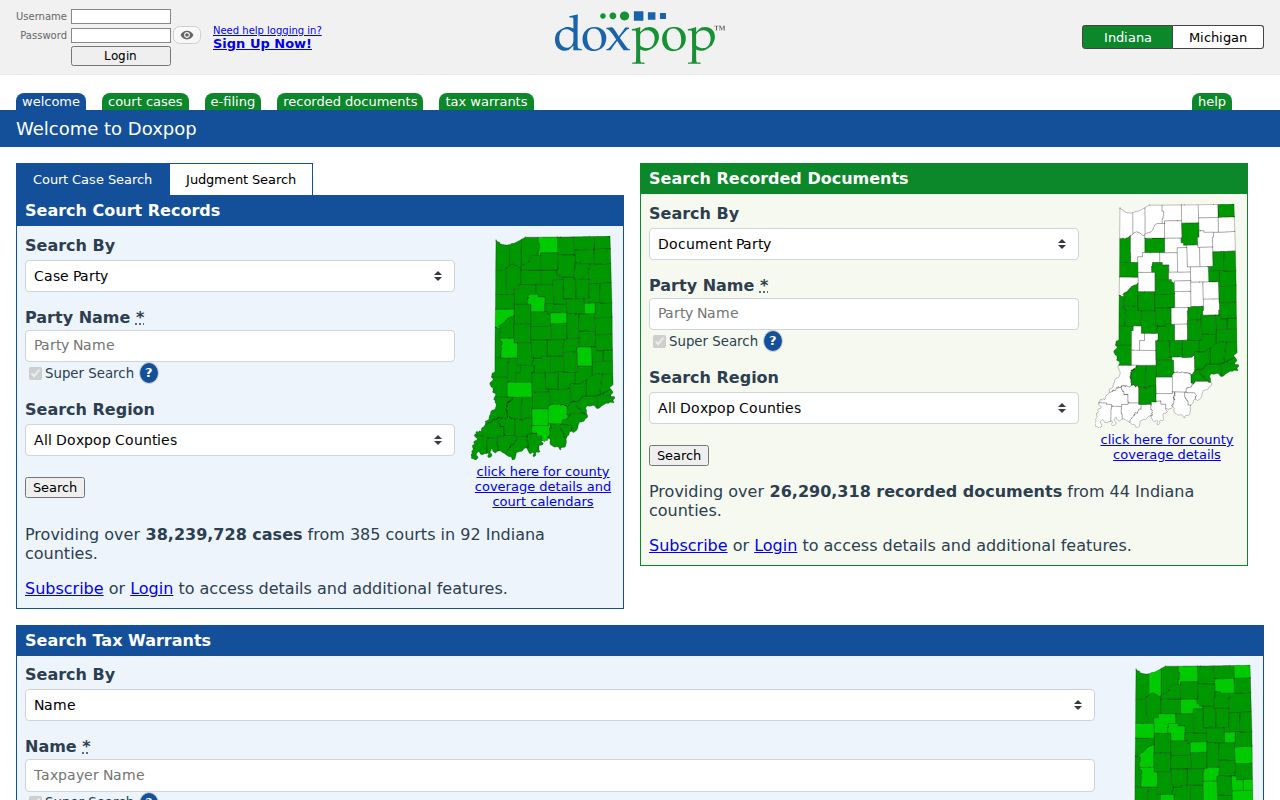
The DoxPop entry page marks the online sign-in point.
The January 1963 Line for Former Owners
The Bartholomew County Recorder sends online land-record researchers to DoxPop. Its document index reaches back to January 1963. That date is an index boundary, nothing more. It does not promise that every image is viewable or that ownership began that year; it simply signals when a researcher should expect a change of access channel.
Online cutoff. For former owners before January 1963, move from DoxPop to deed books, microfilm, county Archives, and State Library finding aids.
Older Bartholomew County Deed Series Extend the Chain
Older Bartholomew County deed series reach much deeper. The Indiana State Library film guide lists a general deed index A-P covering 1822 through 1851, Tax Titles volume 6 for 1865 through 1962, and Sheriff's Deed Records on Decree for 1869 through 1895. It also lists Executions for 1869 through 1921, partition deeds for 1880 through 1890, and many deed runs through the 1880s. One modern search box cannot hold all of that.
Choose the series that fits the event. A court decree may point to a sheriff's deed. An estate may point to probate and a personal representative's deed. A division among owners may point to partition. Capture the volume, page, date, parties, and land wording before moving to the next prior owner.
Use Bartholomew County Plats to Hold the Place
Plats steady a chain when the address changes. The State Library lists Bartholomew County plat books with owner indexes from 1989, 2003, 2012, and 2014, plus Columbus-area and county maps from other years. Maps orient a search. The recorded plat, subdivision certificate, deed, and county endorsements still control the legal description.
A subdivision lot can be traced to its parent tract by reading the plat and then finding the instrument that conveyed or dedicated it. Rural ground is different. Township, range, section, acreage, survey calls, roads, and adjoining owners often matter more than a present mailing address ever could.
Reading a Bartholomew County Chain of Title Backward
The backward method is simple in principle and exacting in practice. The current deed names a grantor. That person's acquisition deed names another grantor, and each link must cover the same land. Record the exceptions, easements, plat language, and prior-instrument references along the way, because they can expose a split or a correction the chain would otherwise miss.
- Copy the current parcel number and legal description, then identify the current owner's acquisition deed.
- Read the grantor exactly as written and note any prior-deed citation.
- Search that former owner as a grantee and confirm that the land description matches.
- Repeat until the online index ends, then use its last book/page clue in the older index and deed books.
- Grantor
- The conveying party; in a backward search, usually the next prior owner to test.
- Grantee
- The party receiving the stated interest in the recorded instrument.
- Chain of title
- The linked sequence of instruments affecting ownership of the same land.
- Reverse index
- An index organized to locate a party in the grantee role when stepping backward.
- Quitclaim and warranty deed
- Different forms of conveyance whose legal effect cannot be reduced to the label alone.
When Probate Breaks a Clean Former-Owner Sequence
A death can interrupt a tidy sequence. Probate may insert a cause, will, order, inventory, affidavit, or estate deed between two familiar owners. Older probate and related books moved to the Indiana State Archives in 2017. The State Library guide also lists probate order-book indexes and wills reaching into the nineteenth century.
Identify the decedent and the approximate date. Inspect the probate record. Match the legal description. Then return to the Recorder for the instrument that placed the land in a successor's name, since a death index alone does not prove that a parcel passed to a given heir.
Ask the Bartholomew County Archives for a Named Record
The county Archives search form accepts a category, a surname or company, a first name, and a keyword or year. Archive copies carry a one-dollar base charge plus ten cents per copy and mailing, according to the county source. Hours vary. Appointments are advised. This channel pays off once the chain has produced a name, an era, and a record type.
Under Indiana APRA, request an existing record with reasonable particularity rather than asking staff to build a family or ownership history. Include a book and page. Add the parcel description, the person or company, and the date range whenever the chain provides them.
Bridge old descriptions to a modern Bartholomew County parcel.
Older deeds may describe a tract through township, range, section, acreage, survey calls, roads, and adjoining owners rather than a parcel number. Later subdivision records may replace that prose with a named plat, block, and lot. Build the bridge in stages. Locate the modern legal description first. Read its prior reference, compare acreage and boundaries, and use the relevant plat or survey to connect the two forms.
Never assume the present parcel equals the historic tract. Land gets divided, combined, dedicated for a road, or carved down by an exception. Track each retained and conveyed piece. A clean former-owner table can include a scope column stating whether an instrument covered the whole current parcel, a parent tract, or only a portion.
How Far Back Bartholomew County Ownership Records Go
Bartholomew County dates to 1821. Its paper trail runs deep, from an Original Tract Book and court records that start in 1822 to deed indexes, deed books, tax-title files, plats, probate series, and archival holdings. A complete ownership chain serves two purposes. It separates the earliest online result from the earliest historic deed you can actually locate, and it flags gaps instead of quietly stitching together two people who merely share a name. Gaps matter. Admitting one is better than inventing continuity.
Keep a log as you go. For every query, note the name, party role, years covered, the result reference, and whether you opened the deed image itself. Then transcribe the legal description, the execution and recording dates, the deed type, and the earlier book-and-page citation. A log like that pays off later. It lets you pick work back up in a physical volume without repeating a broad name search from scratch.
Some owners hide behind corporate names, initials, married surnames, and spelling shifts. Each variant deserves its own pass. A reserved tract or partial conveyance adds another wrinkle, since the grantor may not have conveyed the whole parcel. Map the land actually transferred before you pick the next link. Bartholomew County Historical Society maps and family papers can enrich the picture, but only a recorded transfer proves ownership moved.
For formal title conclusions, weigh the timeline against original recorded images and any later corrective instruments. Tracing backward documents former owners and gaps honestly. It is not a title opinion.
Use the history with care. Research former owners for title, preservation, genealogy, or house history, and never to track or harass a living person.